
I’ve spent a considerable amount of time writing about the challenges of building an independent clinical interventional radiology practice. When I started LineMonkeyMD, much of what I wrote was theoretical. I had strong opinions about the direction of our specialty (still do), the economic relationships that kept interventional radiologists dependent on hospitals, and the importance of developing a clinical identity independent of diagnostic radiology.
Eventually, I decided to do something about it. I left traditional radiology practice and partnered with an interventional cardiologist to build an outpatient practice in North Carolina. I was a minority owner, and while the experience gave me an opportunity to develop the kind of clinical practice I had been advocating for, it also taught me some rather expensive lessons about the business of medicine. I learned about reimbursement, referral development, staffing, management services organizations, financial incentives, and perhaps most importantly, the difference between having equity in a business and having meaningful control over it.
After two years, I left that partnership and spent the next several years working locums while figuring out how I wanted to approach practice ownership again. Eventually, I opened Image Guided Solutions of Missouri, this time with the benefit of everything I’d learned from my first attempt and a much clearer understanding of the kind of business I wanted to build.
Nearly two years into running my own practice, I can say that the experience has been considerably more educational than any conference lecture I’ve attended about physician entrepreneurship. Some of my original assumptions were correct. Others were embarrassingly naive. I’ve developed a much greater appreciation for physicians who have successfully built sustainable clinical practices, and considerably more skepticism toward those who spend their time explaining how everyone else should do it. Particularly those who have made an entire professional identity out of entrepreneurship, innovation, and leadership, often with remarkably little discussion of what they’ve actually accomplished.
The Performance of Accomplishment
Interventional radiology has developed an entire ecosystem of physicians whose professional identities seem to revolve around being recognized as important figures within the specialty. LinkedIn is filled with announcements of leadership appointments, speaking engagements, entrepreneurial ventures, industry collaborations, and the latest revolutionary developments in outpatient IR. Every accomplishment comes with an obligatory expression of humility, and every professional interaction is an extraordinary opportunity to advance patient care.
I don’t begrudge anyone professional success or recognition. I’ve participated in many of these same activities myself. What I find interesting is how little scrutiny we apply to the accomplishments underlying the publicity. We know who’s speaking at the conferences, who’s launching the latest venture, and who’s collaborating with which device manufacturer. But what have they actually built? What problems have they solved? What have they accomplished beyond becoming increasingly recognizable to other interventional radiologists?
We’ve become very good at confusing the performance of accomplishment with accomplishment itself. Building a following isn’t the same as building a business. Being invited to lecture about entrepreneurship doesn’t establish that you’ve successfully practiced it. And appearing on every conference program doesn’t necessarily mean you’ve contributed anything particularly meaningful to the specialty.
Spend enough time following these personalities and certain recognizable characters begin to emerge.
The Aspiring IR Entrepreneur
Perhaps my favorite is the aspiring IR entrepreneur who, barely a few years removed from fellowship, has already decided that the specialty needs his guidance on entrepreneurship, business development, and physician independence. Armed with an LLC, a Substack, and an inexhaustible supply of ideas that other physicians have been discussing for decades, our budding thought leader sets about establishing himself as an authority on the future of IR. Apparently, the secret to innovation is discovering what everyone else has already been doing and announcing it to an audience that wasn’t paying attention the first time.
Traditionally, expertise has been acquired by actually doing something, becoming reasonably good at it, and eventually developing a service around the experience you’ve accumulated. We’ve since discovered a more efficient approach. Start with the service, establish the brand, and worry about acquiring the underlying experience somewhere along the way. Interview a few physicians who have actually built successful practices, publish their insights under your own banner, and suddenly you’re in the business of teaching entrepreneurship.
I have no objection to early-career physicians being ambitious. I was writing about these same issues long before I opened my own practice. But there’s a difference between documenting what you’re learning and positioning yourself as the person everyone else should be learning from. The former is how you develop credibility. The latter is how you manufacture the appearance of it.
The OBL Visionary
Then there’s the academic OBL Visionary, who, after years of practicing within the comfortable confines of an academic institution, has discovered the extraordinary concept of performing procedures outside the hospital. Naturally, this revelation must be shared with the rest of the specialty through an extensive international speaking tour. While someone else handles the considerably less glamorous responsibilities of seeing patients, performing procedures, and keeping the clinic functioning, our visionary can be found traveling from podium to podium explaining the future of outpatient IR. Apparently, the most important qualification for teaching physicians how to operate an independent practice is having someone else available to operate yours.
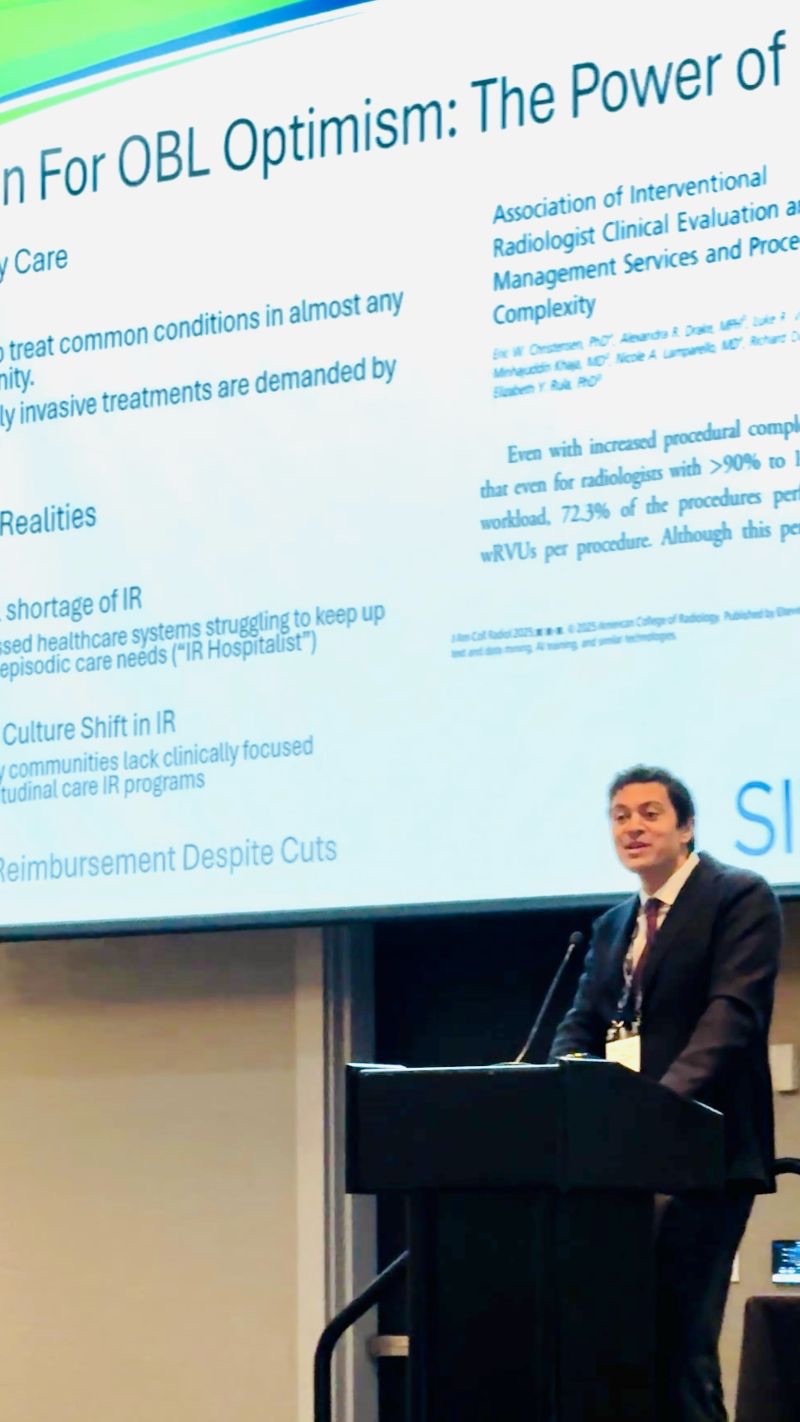
Meanwhile, the definition of independence has become rather flexible. There is a meaningful difference between building a standalone clinical enterprise with its own referral relationships, payer arrangements, and financial infrastructure and operating within the established business structure of another specialty. Both can be legitimate practice models, but they aren’t economically equivalent. Nevertheless, that distinction tends to disappear somewhere between the conference introduction and the obligatory photograph of the speaker standing in front of a slide about physician ownership.
And perhaps the most amusing part of the entire performance is the suggestion that outpatient IR represents some revolutionary new development. Physicians have been building OBLs for decades. But the concept doesn’t officially qualify as innovation until an academic thought leader discovers it and develops a PowerPoint presentation explaining it to everyone else.
The Perpetual Gunner
The Perpetual Gunner is another familiar character. Medical school never really ended for these people. The gold stars have simply become committee appointments, society leadership positions, advisory boards, and professional awards, each announced with the obligatory expression of humility. Every invitation is an honor, every appointment a privilege, and every conference another opportunity to be incredibly humbled and grateful. The academic CV has become a content calendar, and LinkedIn has become the refrigerator where every new achievement gets proudly displayed. No professional accomplishment is too insignificant to warrant a public announcement thanking everyone who made it possible.
What I find particularly amusing is how easily this obsession with professional recognition coexists with the economics of corporate radiology. We spend decades advocating for clinical IR, only to embrace business models in which the most important measure of physician productivity is how many diagnostic wRVUs can be generated. Developing a longitudinal clinical practice requires time, capital, staffing, and patience, none of which fits particularly neatly into a spreadsheet designed to maximize the productivity of radiologists reading studies. It’s difficult to build a clinical specialty when the financial incentives encourage you to spend as little time as possible being a clinician. But I suppose there’s always another committee available to discuss the problem. Perhaps the next leadership appointment will finally solve it.
The Podium Personality
Closely related is the professional Podium Personality, whose career appears to consist of an endless series of conference appearances documenting the importance of his previous conference appearances. Every lecture becomes another opportunity to establish his credentials, every panel discussion reinforces his status as a thought leader, and every interesting procedure becomes another opportunity to demonstrate his expertise to the rest of the specialty. There are discussions about techniques, devices, procedural approaches, and the latest developments in clinical IR. You can spend an entire afternoon listening to these presentations and learn quite a bit about how someone performs a procedure without learning much about the clinical practice in which those procedures are performed.
How many patients does he see? Where do they come from? What does his clinical infrastructure look like? Does the business work? Those are the questions I find considerably more interesting, although I suspect a discussion about referral development and accounts receivable wouldn’t generate nearly as much excitement as another presentation about the latest procedural technique. At some point, I wonder whether the purpose of all this professional visibility is to demonstrate clinical expertise or whether the visibility itself has become the principal accomplishment.
The Physician Lifestyle Influencer
The Physician Lifestyle Influencer takes things a step further by turning the identity of being a physician into the product itself. The scrubs, procedure photographs, conference appearances, corporate partnerships, and carefully curated glimpses of medical life become content, while the audience becomes an asset that can eventually exist independently of clinical practice.
There’s something particularly fascinating about the transformation of independent clinical IR into a lifestyle brand, complete with clothing sponsorships, inspirational entrepreneurship posts, and consulting services for fellow physicians hoping to replicate the same success. At a society-sponsored educational event, we’re treated to stories of building a high-volume prostate artery embolization practice through advertising on sports radio. And for those colleagues interested in learning the secrets of this remarkable business model, entrepreneurial wisdom is available for a rather substantial hourly consulting fee.
Then the clinical practice closes. There’s nothing inherently wrong with closing a medical practice. Businesses evolve, priorities change, and physicians have every right to pursue something different. What interests me is how the entrepreneurial identity can survive independently of the enterprise that supposedly established it. The conferences, sponsorships, consulting opportunities, and professional recognition can continue even after the business itself is gone. Perhaps the most durable thing built along the way wasn’t the clinical practice at all. It was the personal brand built around it.
The Industry Influencer
And then there’s the Industry Influencer, a physician who has never encountered a medical device he wasn’t excited to promote. One week it’s an embolic agent, the next it’s a catheter, followed by an ablation platform or a thrombectomy device. Every product is innovative, every collaboration exciting, and every incremental modification to an existing procedure deserving of its own conference presentation, promotional video, and LinkedIn announcement. You have to admire the consistency. The devices change, the manufacturers change, but the enthusiasm remains remarkably unaffected.
Industry collaboration is essential to our specialty, and there’s nothing wrong with physicians helping develop new technology. But we’ve reached a peculiar point where the ability to generate excitement about a device seems to have become a professional accomplishment in itself. The question is no longer whether a product meaningfully improves patient care, but whether someone sufficiently recognizable can be persuaded to explain why it represents the future of IR. At some point, the distinction between physician educator and freelance marketing department becomes difficult to appreciate. Certainly makes for an interesting CMS Open Payments profile.
The Physician Podcast Network
Of course, the real genius isn’t selling your own credibility to industry. It’s figuring out how to sell everyone else’s. Enter the physician podcast network, where a sponsored conversation can sound considerably more respectable when two or three doctors are delivering it. Find a recognizable physician, put a microphone in front of him, introduce a device as an exciting advancement in patient care, and let the manufacturer sponsor the conversation. The host gets content, the guest gets another opportunity to hear himself talk, the company gets access to potential customers, and everyone congratulates themselves for advancing physician education. What used to require a sales representative, a conference room, and a tray of mediocre sandwiches can now be distributed nationally as a podcast about innovation. The advertising and the educational product begin to look remarkably similar, and the physicians are both the audience and the attraction.
And why stop with IR? Once you’ve figured out how to monetize physician credibility, there’s no reason to limit yourself to one specialty. Expand into cardiology and urology, or whatever field has manufacturers willing to sponsor a conversation. The physicians change, the advertisers change, but the formula remains remarkably similar. We’ve spent decades complaining about other specialties taking our procedures. Apparently, we’ve finally found something to give them in return: industry-sponsored opportunities to listen to ourselves talk.

The Uncomfortable Part
I’m aware there’s an uncomfortable degree of hypocrisy in writing an essay criticizing physicians who build professional brands around interventional radiology. I write a blog about the specialty. I speak at conferences, participate in professional societies, have been featured on multiple industry sponsored podcasts and occasionally enjoy the recognition that comes with those activities. I’m involved in a physician staffing business that benefits from the same hospital dependence I’ve spent years criticizing. There is no question that an unintended consequence of writing long form essays has been the development of a personal brand. And now I’m writing an essay about influencers that I will presumably publish on the internet, where I hope people will read it. I’m very much a participant in the same ecosystem I’m criticizing.
Despite this, I don’t think the problem is visibility, self-promotion, or even monetizing your professional reputation. The problem is authenticity, or increasingly, the lack of it.
There’s nothing wrong with building an audience around your professional experiences, teaching other physicians what you’ve learned, collaborating with industry, or developing a business around your expertise. But we’ve started confusing the ability to present yourself as an authority with actually having earned that authority. The professional identity becomes something carefully constructed for public consumption, with the accomplishments selected, packaged, and promoted to support the narrative.
What I find particularly frustrating is the reluctance to acknowledge the less flattering parts of the journey. Building a clinical practice is difficult. Businesses fail. Partnerships fall apart. Financial assumptions turn out to be wrong. I’ve experienced enough of these things myself to appreciate how much there is to learn from them. But those experiences rarely make it into the inspirational LinkedIn posts or conference presentations. Instead, we’re treated to a remarkably consistent collection of success stories, each one conveniently reinforcing the speaker’s credentials as an entrepreneur, innovator, or thought leader.
I have considerably more respect for someone who admits that a business didn’t work than someone who promotes an image of entrepreneurial success without ever discussing what actually happened. There’s nothing particularly impressive about being successful on social media. What’s impressive is being willing to describe your experiences accurately, including the parts that don’t make you look particularly successful.
I’ve never claimed to have all the answers about independent clinical IR. I’m still learning, and I expect I’ll continue making mistakes and you’ll keep hearing about them on this blog. My opinions have changed as I’ve gained experience, and I’ve tried to be reasonably transparent about why. I don’t think that makes me particularly special. It just seems like a more useful way to contribute to the conversation than manufacturing an image of expertise that may or may not correspond to reality.
Plenty of physicians have built successful outpatient practices without receiving a fraction of the attention devoted to the latest generation of professional thought leaders. Others have tried and failed, learned from their mistakes, and moved on to something else. I have respect for both. What matters to me is whether the person presenting the story is being honest about what actually happened. There’s far more to learn from someone willing to discuss the realities of their experience than from someone whose professional life appears to be an uninterrupted series of accomplishments, exciting announcements, and extraordinary opportunities.
I don’t expect every physician who speaks at a conference or starts a podcast to have built a successful business. I do expect them to be authentic about what they’ve done, what they’ve learned, and what qualifies them to offer advice to everyone else. We’ve started rewarding the ability to look accomplished more than the work required to become accomplished. And until we start recognizing the difference, we’ll continue producing more influencers than people worth being influenced by.
Kavi, insightful and hysterically funny—the IR mug had me laughing out loud! Your plea for authenticity really resonates.
Building a practice leaves scars: money wasted, time lost, and plenty of blood, sweat, and tears. I’ve certainly paid my share of that tuition building my practice and other businesses.
At our HPS Vein Care Summits, physicians and practice leaders throughout the network freely share those experiences—what worked, what failed, what it cost, and what we would do differently. There’s tremendous value in being able to tell a colleague, “Here’s where I got it wrong, and here’s what I learned.” That openness is something everyone contributes to and benefits from.
IR physicians could benefit enormously from more of that kind of community, where colleagues can ask for help, compare experiences, and learn from one another’s hard lessons.
Thank you for encouraging that honesty, Kavi. We’ve already paid for these lessons. Sharing them may spare someone else some of the expense and heartache.