I just returned from the SIR Business of IR meeting in Atlanta. I left energized, but also a bit unsettled. And honestly, I’ve been feeling unsettled for some time, so please don’t get the impression that the meeting impacted how I have been feeling.
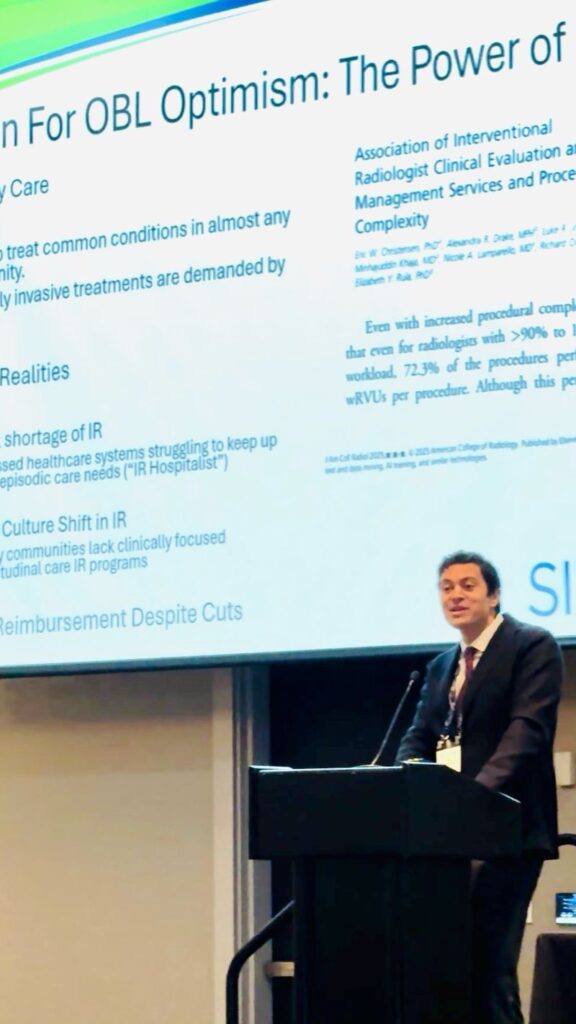
This meeting is truly one of the few spaces where interventional radiologists from diverse backgrounds can honestly discuss the future of our specialty. It’s practical, candid, and necessary. I want to thank SIR for the invitation to present — sharing my experience with Image Guided Solutions of Missouri and how I am building my practice to survive in today’s challenging healthcare environment was a privilege. I discussed the strategies, decisions, and operational steps that allowed my office-based lab to achieve profitability despite the negative trends facing physicians: consolidation, employment pressures, and declining independence. It was an opportunity to provide practical insight into building a longitudinal IR practice in a system increasingly stacked against small, independent operators.
But beyond my talk, the broader discussion left me thinking hard about what independence actually means and what it will take to preserve it in the coming decade.
Independence: It’s Not Just About Radiology
“Independent IR” gets used a lot. Too often, it’s applied loosely, without acknowledging the structural realities that define it.
For some, independence is operational: separation from diagnostic radiology, separate budgets, distinct governance, a clinical identity that is recognizable and defensible. Over the years, I’ve been very critical of mixed IR/DR arrangements and have called for true separation. Without clear boundaries, IR becomes invisible in decision-making and undervalued in the marketplace. I’ve written about this extensively in past posts, including IR & DR: The Dirty Truth.
The central point is this: longitudinal clinical care — following patients over time, understanding and engaging in non-operative management, owning outcomes, maintaining procedural continuity — is what should unite all modern IRs, regardless of employment or practice setting. This continuity defines the specialty and underpins clinical value, and our ability to provide longitudinal care through minimally invasive image guided procedures across different organ systems differentiates IR from other procedural fields.
Private practice is critical here. It defines IR in community and rural settings. Without independent practices, our field risks being defined for us by administrators, corporate structures, and policy frameworks that prioritize scale and profit over continuity and patient-centered care. Private practice is the mechanism through which IR asserts its identity and demonstrates value outside the walls of tertiary care centers. It allows entrepreneurial IRs to innovate and expand access to care in communities that need it the most.
That said, mechanisms often used to demonstrate value — PSAs with billing rights transferred to hospitals, employment arrangements, or hybrid models — are double-edged. They create leverage today but subtly erode autonomy tomorrow. Every structural decision that places IR under a health system risks moving the specialty toward mass employment. The office-based setting remains the only site where true independence is feasible, where IRs can achieve market rates through Medicare Physician Fee Schedule (MPFS) payments without ceding decision-making power or financial control.
Our specialty has matured significantly over the past decade, carving out a distinct marketplace identity separate from DR. From formal ABMS recognition to independent IR departments in academic and community settings, the specialty has demonstrated serious progression. This separation is not just bureaucratic—it is critical for sustainability, visibility, and patient-centered care. It is clear that most progressive IRs, and our primary SIR leadership has largely moved beyond a DR centric model. All we need now is a distinct IR-only certification to help us eliminate pseduo-exclusive contracts.
The Data Are Unforgiving
There is no longitudinal dataset tracking IR-only employment status. IR trends are inferred from national physician workforce data, radiology employment analyses, and SIR workforce discussions. It is estimated that greater than 70% of IRs are now employed by healthcare systems or corporate systems.
Physician employment is the dominant operating model in U.S. medicine. The AMA Physician Practice Benchmark Surveys document a steady migration away from independent ownership with no meaningful reversal over the past decade. Radiology, and by extension IR, has followed this trajectory closely, as reflected in workforce analyses from MGMA and the American College of Radiology.
What has delayed widespread employment in IR until recently is structural cross-subsidization. For decades, many IRs have remained embedded within diagnostic radiology groups, spreading fixed costs, call burdens, and operational inefficiencies across DR revenue. That hybrid model has functioned as a buffer — not a moat. As IR continues to separate from DR and assert a longitudinal clinical identity, the same consolidation pressures seen across medicine become harder to avoid. Layer in accelerating hospital consolidation — now encompassing roughly two-thirds of U.S. hospitals per the American Hospital Association — and the risk is clear: autonomy becomes conditional unless it is structurally protected.
The Final Session: Speaking the Quiet Part Out Loud
During the session on the future of Independent IR, moderated by Dr. Matt Hawkins with panelists Dr. Nick Petruzzi, Dr. Julie Bulman, and Dr. Ezekiel Silva, I asked what many of us are thinking:
What is keeping IR from suffering the same fate as the rest of medicine — widespread employment?
The answers were honest. Without robust advocacy, many IRs will eventually be absorbed by large health systems or corporate entities, regardless of talent or performance.
Dr. Hawkins noted that IRs who can demonstrate value through growth or differentiated clinical services may continue to thrive under PSA arrangements, preserving some autonomy. But alignment with systems always comes at a cost.
He also said hospitals aren’t inherently bad. Some administrators may genuinely mean well. But large, consolidated healthcare “non-profit” systems increasingly behave like hedge funds: consolidating power, reducing patient access through opaque contracting, and prioritizing revenue over outcomes. Super Bowl ads? Insurance premiums at all-time highs? That’s not community care — that’s monopoly economics in action.
Dr. Silva shared a sobering insight from a senior administrator, perhaps a physician in HHS and maybe one who used to be on TV: physicians don’t need to be doing 20% of what we currently do. The implication is clear: work traditionally performed by physicians will be taken over by other providers. IR has been relatively spared — for now — but the trajectory is obvious.
I want to personally thank Dr. Silva — Chair of the AMA RUC — for his tireless work protecting IR interests in national payment policy. Similarly, Dr. Robert Kennedy (SIR), and Dr. Curtis Anderson (OEIS) deserve recognition for representing IR procedural valuation on the RUC. Their advocacy largely happens behind the scenes but has real consequences for how our work is valued and for our specialty’s survival. It is very easy to be critical of the AMA RUC process, and rightfully so, but this is the mechanism we have right now, and it requires serious work to advocate for our field.
Why Employment Is a Threat, Not Just a Concept
I know some reading this may view employment as a viable option, and perhaps their best option for now. Please hear me out.
Employment turns physicians from value creators into cost centers. When margins tighten, cost centers are optimized first.
Compensation may look attractive now, but markets recalibrate. Procedures become standardized, APPs increasingly meet procedural demand — particularly in rural and community settings. When labor becomes substitutable, autonomy vanishes. It’ll start with trash, and it will make its way to destroy our treasure.
Other consequences are tangible:
- Loss of control over schedule, staffing, and clinical decision-making
- Exposure to institutional cost-cutting measures
- Burnout driven by productivity metrics misaligned with patient care
- Few exit options as systems consolidate
Studies confirm that physicians in ownership models maintain higher satisfaction, even with increased stress.
Protecting True Private Practice IR
Independence survives only through policy, structure, and collective action.
This requires:
- Advocacy against reimbursement models that favor scale over outcomes
- Contracting that doesn’t systematically disadvantage small practices
- Legislative reforms eliminating current regulatory capture mechanisms
- Transparency in defining and assigning “value”
Private practice is the means by which IR defines its identity, preserves longitudinal care, and secures its place in community and rural settings. Without it, administrators will write the definition of IR for us — and it won’t center patient care or clinical autonomy.
Call to Action: Step Up or Step Aside
Independence is fragile. I know better than anyone that it is easy to get on the internet and criticize things, but real change has to happen with action. I have increased my participation in my professional societies as a board member of OEIS and now as vice counselor of the Practice Management Division of SIR. Its hard to do this as a solo practitioner as I’m not afforded paid academic time and meeting ribbons that can function as wardrobe accessories don’t provide me any career advancement, but I do it because I want to fight hard for a better future. Everyone I know who cares about IR who has reached out to me over the years needs to step up, now more than ever.
To preserve IR’s autonomy, we must:
- Engage in advocacy now — every PSA negotiation, every Medicare comment, every RUC survey, every legislative moment counts. Everyone needs to donate to a society PAC. I will be making a max contribution this year and every attending reading this needs to do the same.
- Teach trainees the systemic threats to private practice — governance, market forces, structural risk. Academic IR is critical for teaching and research advancements, but remember the majority of us will end up in private practice.
- Collaborate across IR — share strategies and lessons to maintain leverage
- Be actively involved in SIR and OEIS. While I have been critical of SIR in the past, I see meaningful change in the organization’s engagement of private practice members, including OBL owners, in leadership. Our involvement is critical. Without it, the specialty will be defined for us, not by us. OEIS has consistently punched above its weight class, supporting the only site of service surviving in the current MPFS structure, and deserves our support. The SIR and OEIS need to work better together and I hope to help bridge that gap the best I can.
If IR wants a future that includes true private practice, we must defend it actively. Otherwise, the “independent IR” movement we are building today will quietly disappear.
Solid post… 👏
Thanks!
Hey Dr. Devulapalli, how do you see the trend toward value-based and managed care systems, like Medicare Advantage, affecting the specialty? A hospital CEO I spoke with suggested that clinical IR could actually make a stronger case for itself outside of fee-for-service, given the increased emphasis on outcomes and cost cutting, combined with less internal pressure to crush film. I’m a bit skeptical, since most specialists still seem to have some mix of productivity-based and salary compensation even in these systems, but as an MS4, I’m mostly speculating.
Hi Kevin, good question. No one can truly define what “value-based care” (VBC) actually means. Medicare Advantage (MA) plans are basically privatized Medicare which still pay specialists based on a fee-for-service (FFS) basis. It’s like the worst of both worlds: Medicare rates with commercial insurance denials. It’s popular among patients because premiums are lower than traditional Medicare. The only way for insurance companies administering these plans to make money is to collect premiums and deny care, especially seemingly expensive specialty care like endovascular procedures.
I think the CEO is probably right, but FFS still dominates and hasn’t changed meaningfully despite new gimmicks like MIPS and MA.
Not to be too pessimistic, but what scares me is payment outside of services rendered is dependent on factors out of our control: patient adherence, specialty coordination and administrative competence. How is that possible when all data shows that we as a nation spend the most on healthcare yet have subpar population health outcomes? While everyone is quick to point the finger at physicians, physician payment accounts for less than 8% of the 4.7 TRILLION annual healthcare spend which accounts for more than 20% of GDP.
Money is being siphoned off by third parties, namely health insurance companies and “not-for profit” healthcare systems. When indexed to inflation, physician payment has decreased over 50% over a 30 year period. IR in particular has been hit the hardest with a 30% reduction over the last decade.
80% of physicians are now employed by corporate entities and healthcare systems. They have little to no control over their practices and are pressured by their employers to meet rvu quotas. It’s no different in IR than other fields except we are several steps behind still identifying our specialty and proving a distinct practice pattern from DR.
IR is VALUABLE on multiple levels. We have novel minimally invasive treatments for common conditions that affect over 50M Americans, all of which can be done outpatient. We are the glue for hospitals who need us to decrease length of stay and prevent expensive transfers. We are valuable for many other specialties who need our expertise to care for their patients.
How do we prove our worth when 4/5 of us are now employed by administrators who have no idea who we are? How does that fold into future VBC pathways?
I think anyone who says they know the answer is full of it.
That’s the honest truth.
This is why practice independence, ie PRIVATE PRACTICE is critical for IR, probably more so than any other field of medicine. We cannot define who we are and what we do unless we have the freedom to build practices. By being employed we are at the mercy of administrators who may not understand us and more importantly may not ever care to understand us.
The future is bright only if we can fight for our worth and value. I would not look at VBC plans as the answer to that because at the end of the day the goal of those plans is to decrease our pay and increase our liability. Because of our moral obligations to patients, physicians remain the greatest shock-absorber for the healthcare system. Administrators know this and take full advantage.
I’m merely finishing up my MS3, but I’d much rather get paid less in the future than lose my autonomy and have some healthcare administrator who doesn’t know the breadth and depth of my abilities tell me what I can or cannot do for my patients. If my internal medicine rotation taught me one thing, that is IR touches absolutely every single specialty in a quaternary medical hospital. We’ve had patients stay through the weekend because IR doesn’t work on the weekends. Because of the contract obligations they have to the DR group, the IRs can’t even offer their services on the weekends.
The problem is most trainees go to programs that prepare them for image interpretation and “lite” IR . The other thing that most trainees is get technical exposure to IO and hepatobiliary which works well for a transplant center, but not for the majority of community based practices.
They do not get enough dedicated clinic time to comprehensively manage disease entities such as BPH/LUTS, fibroids, Knee pain, back pain, osteoporosis, PAD, diabetic wounds, superficial venous disease etc. Most other specialties spend a large amount of time focused on clinics, consults, inpatient admissions, and ICU care.
Trainees are reliant on specialists to send referrals and are not able to manage disease. They presume that imaging is what makes them unique, but that does not get patients into your clinic. The focus should be on building your clinical chops, learn E and M and how to negotiate with getting hospital contracts separate from DR and how to negotiate rates for procedures from insurance companies etc. These are poorly taught in training as the focus is to get through the list (whether it be imaging studies or procedures).