I arrived yesterday in Toronto for SIR 2026. As we head into our annual meeting, I am excited. There have been some great conversations leading up to this meeting regarding the future of IR and the direction we are taking as a specialty. We are seeing a push towards IR-only practice, and it is clear that, as a society, we have made strides towards a new future.
As encouraging as all this is, I keep coming back to the same question in my head:
Can Interventional Radiology actually stand on its own as a specialty?
Not in the way we talk about it at meetings or present it to trainees, but in the real world, where patients have to find you, and where revenue from your IR work actually supports your practice, and where no one is obligated to send you anything.
My career has been a pursuit of independence. Financial independence from hospitals, diagnostic radiology and other specialties, autonomy over my clinical practice, and the ability to define what it is that I do in a system that increasingly prefers to define that for you. That’s what led me to build Image Guided Solutions of Missouri. It is working, and I believe in what we’re doing, but it is also a grind in a way that I don’t think is fully appreciated unless you’ve actually tried to do it yourself, because most people never actually have to.
What makes that harder to ignore is how many easier paths exist right now, and how rational those paths look when you step back and think about them. You can read from home, you can do locums, or maybe a combination of the two. You can work in a multitude of settings, distilled down to stepping into a system someone else has already built, and you just function within it. In many cases, those paths pay more, they’re more predictable, and they don’t require you to build anything from the ground up. That’s the reality we’re operating in, and if that’s the reality, then we should at least be honest about what we are incentivizing as a field.
Because we say we are a clinical specialty, we talk about independence, we talk about growth and innovation, but when you look at how careers are actually being built, they often move in the opposite direction. We still recruit students with some version of “you get to do procedures without the surgical lifestyle,” and that message lands exactly as you would expect. Surgery lite becomes the identity, whether we intend it or not, and people build careers that reflect exactly that, with limited clinic, limited responsibility outside the procedure, and efficient procedural work inside systems that already exist. That’s exactly what we told them this field was.
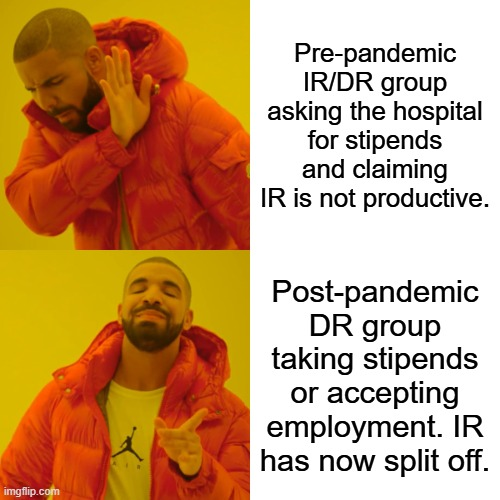
At the same time, the structure around us is shifting in ways that should make us more uncomfortable than they do. The transition from IR-DR private practice models supported by diagnostic revenue to employment models and hospital-controlled systems is well underway, and it mirrors what is happening across the rest of healthcare. In the outpatient space, independent practices are disappearing while corporate entities and specialty-owned groups continue to expand, and IR increasingly appears as an add-on to those systems rather than as something that defines them. We are also watching procedures we developed and refined move into other specialties that already control the patient relationship, and none of this should surprise anyone once you consider how medicine actually works.
Trying to build IGS forced me into that realization in a way that was not theoretical. Working in a rural setting, you don’t have the luxury of a steady stream of fully worked-up consults. Patients show up with problems, not diagnoses, and those problems don’t always map cleanly to what you were trained to do. Back pain, leg pain, pelvic symptoms, things that don’t line up neatly with a procedure, and you either figure it out or you don’t have a practice.
That means the clinic becomes central, whether you like it or not, and it means spending time on patients who may never become procedural candidates, and it means managing things that fall outside what most of us were formally trained to handle. You start to realize pretty quickly that the gap isn’t because we’re incapable, it’s because we’ve built a system where we haven’t had to develop those skills consistently.
The referral piece becomes very real once you try to step outside of it. Anyone who has tried to build a UFE or PAE practice without shared incentives understands how fragile those pathways can be. Even when referrals exist, they are rarely enough on their own to build something sustainable, which forces you into a different way of thinking about how patients find you and why they would come to you in the first place, and that’s where most of the real work actually is.
Before going further, it’s worth being clear about what I mean by independence, because I’ve written about this before, and it keeps getting reduced to things that aren’t really the point. Independence is not just about being employed or not, although that does matter, and I do think private practice is necessary to support it if we care about where this field is going. It’s also not just about owning an OBL or working for yourself. Those are just structures.
I’ve written about this before in IR and DR: The Dirty Truth, but the reality is that our relationship with diagnostic radiology has always been about more than just business structure. It’s culture, it’s identity, it’s how we see ourselves and how we’ve been trained to function within a larger system. And if we are serious about being a clinical specialty, it’s hard to argue that we can stay structurally and culturally tied to something else and fully define ourselves at the same time. At some point, that has to change if we’re serious about this.
Once you actually try to build something, you realize the question isn’t just whether we can separate from diagnostic radiology. It’s whether we can exist without being fed by anyone else. Whether we can attract patients, manage them, and build practices that don’t rely on someone else’s clinic to fill our schedule. That’s a very different standard.
I think we’ve convinced ourselves that some of these newer models (see below) solve that. Embedding into other specialties, aligning incentives, building inside existing systems, we call that innovation. It works, it looks like growth, and it makes things easier.
But it doesn’t answer the question of whether we can be independent. If anything, it kicks the can down the road.
Here is what we need to ask ourselves:
- Are we capable of building financially viable practices without relying on other specialties?
- Can we actually take care of undifferentiated patients from the beginning?
- Can we build pathways where patients come to us directly?
- Can we explain our value without leaning on cost savings or downstream revenue?
- Are we willing to take a harder path to build something that actually lasts?
There’s another part of this that bothers me, and I don’t think we’ve been honest about it. We are giving away pieces of our field. We call it collaboration, we call it improving access, and sometimes that’s true, but a lot of the time, we are teaching other specialties how to do what we do, embedding ourselves in their practices, and accepting roles where we show up to do procedures and then leave. Over time, that changes how IR is seen: not as a specialty that manages patients, but as a set of procedures that can live anywhere. Once that starts happening, it erodes the specialty whether we want to admit it or not.
Collaboration, Not Subordination
The MSO-backed model is another part of this that we keep talking around instead of just saying what it is. IR is being built into larger clinical platforms, tied to specialties that already control the patient care pathway, backed by capital, scaled quickly because the infrastructure is already in place, and, of course, it works because that’s exactly what it’s designed to do.
But it’s not independence, and I think we need to stop pretending that it is or that it somehow gets us there over time. When IR exists within someone else’s clinical and financial structure, where they control patient flow and the economics, we are not building something of our own; we are fitting into something that already exists, and over time, that matters more than we want to admit.
Because the more we embed ourselves into those systems, the less necessary we become as a standalone specialty. The procedures don’t have to leave their ecosystem; the patient never really leaves their care pathway, and what we do becomes easier to internalize and absorb. It sets the precedent that IR is an ancillary service within a practice owned by another specialty. That’s not a hypothetical outcome; that’s how every other part of medicine has evolved when one group controls access to the patient, and another group doesn’t. We become commoditized. That is actively happening, and it should scare you. I say this not to criticize my friends and colleagues who work in these settings, but to view this through a specialty-specific lens and think strategically about our collective future.
This is where the collaboration argument starts to fall apart. Collaboration is not the issue, and it shouldn’t be, but if we’re not in the patient care pathway early, someone else decides where we fit, and once that happens consistently, we’re not shaping anything; we’re reacting to decisions already made.
That’s the part I don’t think we’re taking seriously enough, not because people don’t see it, but because the short-term version of these models works well enough on a spreadsheet that we don’t feel the pressure to think about where it leads. People are looking to scale and exit. End-stage capitalism.
What has been frustrating to me is not that any of this exists; it’s how little urgency there is around it. We talk about IR as if it is already a fully formed clinical specialty, but when you look at how we train, how we practice, and how we structure our careers, there is a gap between what we say and what we are actually building.
I don’t think we take ourselves as seriously as we say we do, and if we did, independence wouldn’t feel optional; it would feel necessary. For me, it is mandatory.
So can IR stand alone?
It absolutely can, and it should. But it doesn’t happen by default. It requires making uncomfortable decisions and accepting short-term pain for something that is actually sustainable over time, and we, as a community, have not shown that we’re willing to do that yet.
I’m excited about the direction the society is heading, but we need to push even harder, and that starts with community IRs actually engaging with the society and being willing to define what independent IR looks like in their own communities. It involves making difficult decisions and re-evaluating how we care for patients and structure our practices. The community must lead and internalize the belief that we can and should be strong, independent practitioners who define the future of medicine and healthcare.
As we head into SIR 2026, I’m less interested in what the next device can do and more interested in whether we are willing to take this question seriously in our actual practices.
Because if we don’t define what IR is, someone else will.